Thursday, 22 July 2010


Back online mid August...


Thursday, 15 July 2010

Barbara Kasten


Using constructed abstract environments, mirrors, subtly lit planes of glass or blurred, inanimate objects for her subject matter, photographer Barbara Kasten creates images that frequent leave the viewer baffled and bedazzled. She builds complicated environments then carefully lights them, sometimes creating technicolour abstract collisions, other times allusive, enigmatic shades and shadows. Looking at her work its often hard to deduce exactly what you're looking at, and the brain struggles to get a sense of scale - something not that common in photography. Kasten encourages this sense of confusion by keeping recognisable reference points out of the photographs. Even when photographing actual objects or places, such as classical statues, or archaeological digs in New Mexico or Turkey, the images are lit so as to appear staged and unreal, or pushed out of focus to the blurred limits of perception.
The Bauhaus movement, Constructivism, Abstract Expressionism (the Juxtaposition series features Pollock's drip paintings), and 1980s architectures have all influenced Kasten, who has been shooting for over thirty years now, and her photographs have mirrored the prevailing trends in art over the decades. She cleverly manages to use contemporary references in all her series, whilst staying true to her vision.


From the 'Architectural' series, 1980s


From the 'Studio Construct' series, 2007


From the 'New Mexico' series, 1990s


From the 'Construct' series, 1980s


From the 'Juxtaposition' series, 1980s


From the 'Greece' series, 1990s


From the 'Studio Construct' series, 2007


From the 'Architectural' series, 1980s


From the 'Greece' series, 1990s


From the 'Construct' series, 1990s


From the 'New Mexico' series, 1990s


From the 'Architectural' series, 1980s


From the 'Incidence' series, 2010


From the 'Juxtaposition' series, 1980s


All images © Barbara Kasten


Thursday, 1 July 2010

Michael Gira


An unflinching, uncompromising character, Michael Gira is best known as the founder of Young God Records and the leader of Swans, one of the most brutal, relentless and downright loud bands to ever exist. Musical legend tells of the walls of venues quaking as they cranked up the volume of their early live sets in the 1980s, and of fans vomiting as the sheer noise pummeled their organs. Definitely an acquired taste, Swans are justly infamous for their music, but Gira also masterminded the artwork for all their releases over the years, which deserves recognition in its own right. Simple, stark and powerful, it reflected the bleakness and brutality of the band's music and has stood the test of time as a great example of band identity and sleeve design. Using large sans serif typeface and slabs or bands of colour, coupled with simple, iconic symbolism, Gira, together with Paul White of Me Company in the early years, created an aesthetic which he has carried through his twenty-plus years of music. After folding Swans, Gira took this pared down identity to his next band, The Angels Of Light. There's a recognisable evolution to the design over the years, which leaves you in no doubt who is behind the music
Not all of the sleeves were effective, but shown below, in vaguely chronological but by no means complete order, are some of the standouts. Such consistency over so many years makes for one of the strongest bodies of album artwork of the last few decades.
For all his cynicism and bleakness, Gira is not averse to the odd bit of wry humour, the lyrics of his songs occasionally raising a smile, as do the sleeves to Feel Good Now or the strange rabbit-men on the Love Of Life and White Light... covers. He recently announced he is restarting Swans since he longs to be subsumed by noise once more, so it will be interesting to see how the art and identity of the new album appear.


Swans, 1984


Cop, 1984


A Screw, 1986


Greed, 1986


Greed, reverse, 1986


Holy Money, 1986


Holy Money, reverse, 1986


Public Castration Is A Good Idea, 1986


New Mind, 1987


New Mind, reverse, 1987


Feel Good Now, 1989


White Light From The Mouth Of Infinity, 1991


Love Of Life, 1992


Celebrity Lifestyle, 1994


The Great Annihilator, 1995


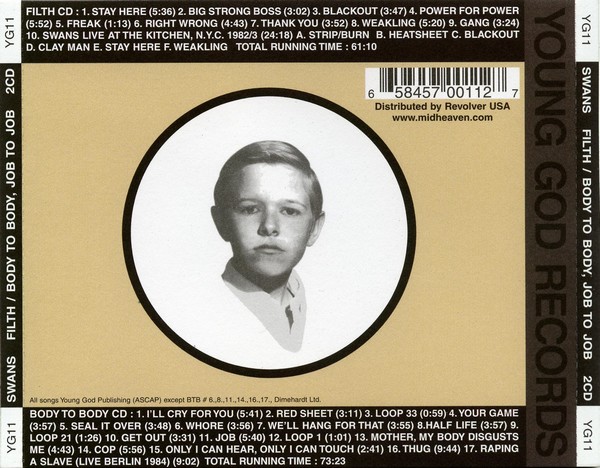
Filth/Body To Body, Job To Job CD reissue, 2000


Filth/Body To Body, Job To Job CD reissue, reverse, 2000


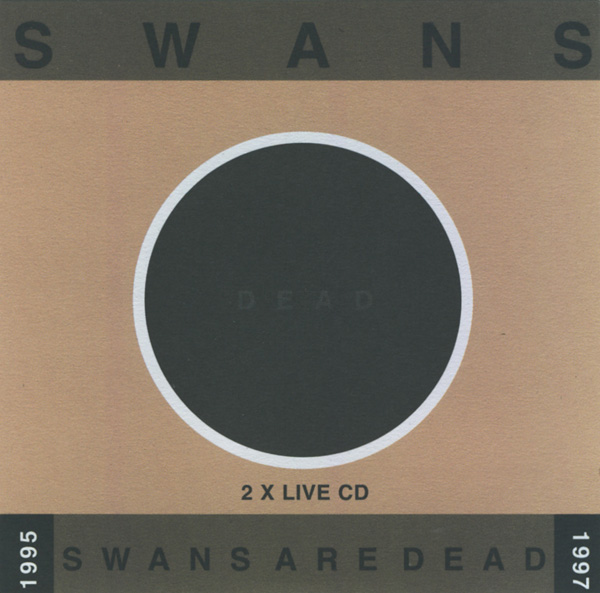
Swans Are Dead, 1998


Swans Are Dead, reverse, 1998


Children Of God/World Of Skin CD reissue, 1997


Soundtracks For The Blind, 1996


New Mother, 1999


How I Loved You, 2001


Everything Is Good Here/Please Come Home, 2003


Praise Your Name, 1999


A portrait of Gira on the reverse of Praise Your Name, 1999


Friday, 25 June 2010

Trevor Paglen


A geographer, photographer and documentarian, Trevor Paglen explores and attempts to reveal the clandestine world of US Military 'black ops', and to fill in some of the blank areas on the map. From locating and photographing secret bases, to snatched images of 'extraordinary rendition' flights transporting terror suspects, to patches and insignia from covert military missions, Paglen's output is far from conventional. In fact, despite having gallery representation, he's more like a conspiracy theorist, but a credible one who goes out of his way to play down any wacky theories, and attempts to document as much of this murky world as possible, thus letting his work do the talking for him. He frequently employs absurdly complicated measures to locate and photograph his subject matter: plotting the trajectories of secret US military satellites and taking long exposure shots of the night sky in an attempt to capture their path; shooting a biological weapons proving ground from over 40 miles away, resulting in a blurry, hazy but ultimately chilling image. 
Paglen details his findings sporadically on a blog, and word of his work has spread, so he now finds himself receiving anonymous packages from people inside the military world, who seem keen to aid him in his work. The mission patches are particularly fascinating;  its been a long tradition in the US armed forces to create a unique patch for each testing mission or project, no matter how top secret, and some of these have found their way to Paglen. The symbolism and graphics on these patches are open to interpretation, and comic as they can look they do invariably allude to what the aim of the mission was. The favoured image of a snarling dragon ensaring the globe is pretty disconcerting, but perhaps somehow fitting - in the days before the world was fully mapped and charted, cartographers used to write 'here be dragons' to mark unknown areas. These unknown, unmapped areas are now deliberate blank spots on maps created by the military machine, and the dragons now represent very different beasts indeed.


Large Hangars and Fuel Storage, Tonopah Test Range, NV. Distance - 18 miles


Chemical and Biological Weapons Proving Ground, Dugway, UT. Distance - 42 miles, 11:17am


Chemical and Biological Weapons Proving Ground, Dugway, UT. Distance - 42 miles, 10:51am


Morning Commute (Gold Coast Terminal), Las Vegas, NV. Distance - 1 mile, 6:26am


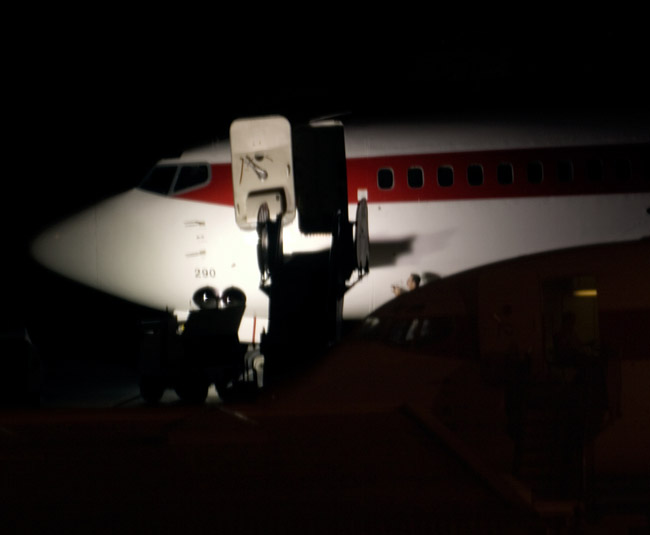
Unmarked 737 at Gold Coast Terminal, Las Vegas, NV. Distance - 1 mile, 10:44pm


Keyhole Improved Crystal from Glacier Point (Optical Reconnaissance Satellite), 2008


Milstar 3 in Sagittarius (Inactive Communication and Targeting Satellite; USA 143), 2008


DMSP 5B/F4 from Pyramid Lake Indian Reservation (Military Meteorological Satellite; 1973-054A), 2009


Nine Reconnaissance Satellites over the Sonora Pass, 2008


All images © Trevor Paglen